


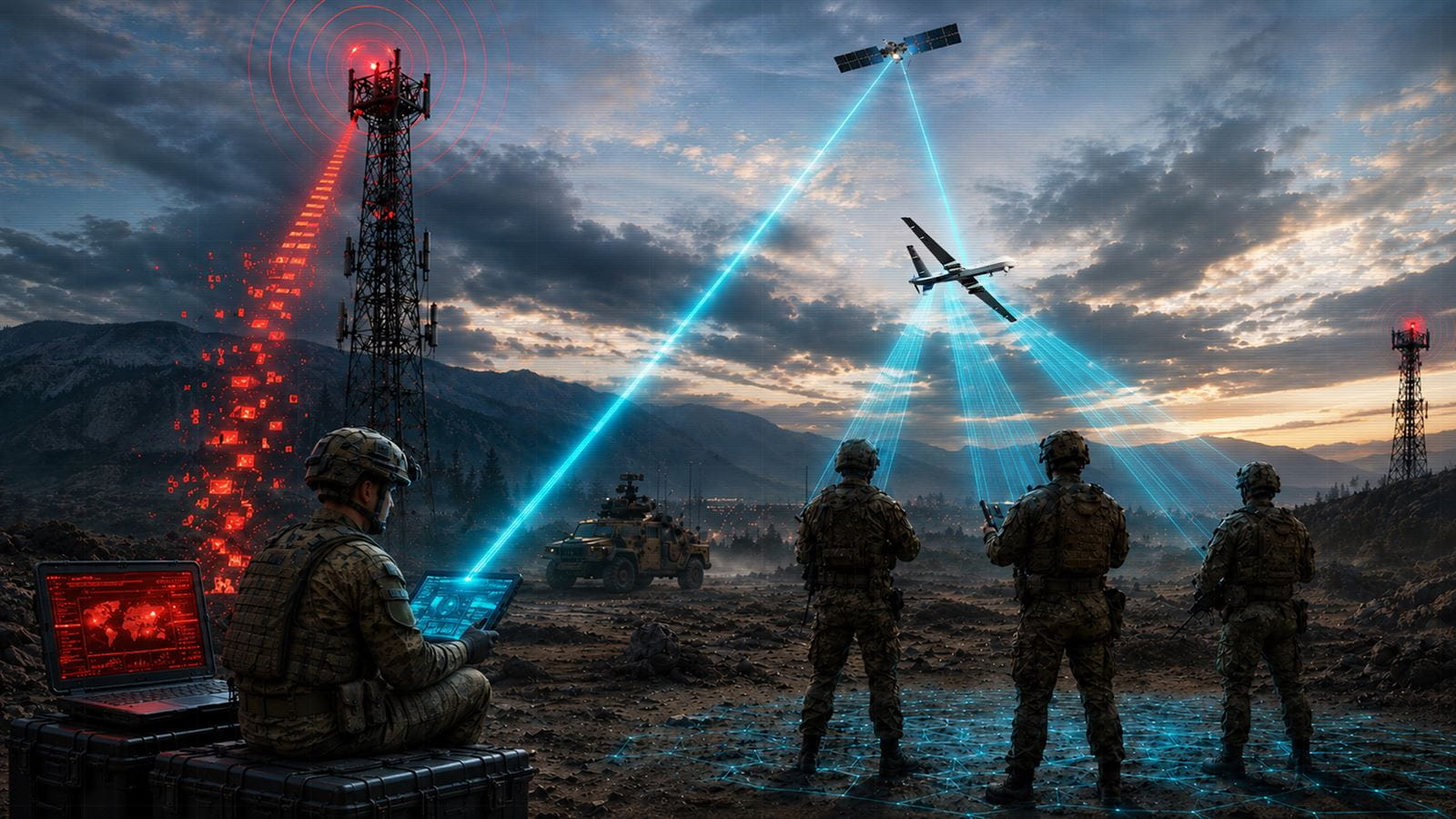
RTX’s BBN Technologies, supported by funding from the U.S. Air Force Research Laboratory (AFRL), has demonstrated a self-healing communications system designed to ensure continuous and secure data flow for combat air support operations in contested environments.
The system, known as PACE4ACE (Primary, Alternate, Contingency, and Emergency for Agile Combat Employment), automatically reroutes network traffic across available communication pathways, maintaining connectivity without operator intervention. It is designed to operate across satellite links, tactical radios, and other military and commercial communication networks.
During demonstrations, geographically dispersed sites remained connected even when high-capacity links were disrupted, with the system seamlessly switching to alternative waveforms to preserve situational awareness and mission continuity.
“For warfighters on the ground and in the cockpit, PACE4ACE helps ensure critical data never disappears, even under jamming,” said Dr. Sam Nelson, principal investigator at RTX BBN Technologies. “The network self-heals, so crews can focus on the mission instead of troubleshooting communications.”
PACE4ACE is designed to integrate with mission systems such as Open Mission Systems and Team Awareness Kit, enabling real-time situational awareness across distributed air operations.
The architecture incorporates multiband support, plug-and-play integration, and a low size, weight, and power (SWaP) design suited for constrained operational environments. It also enables adaptive routing to maintain performance under rapidly changing network conditions.
The demonstration validates the Agile Combat Employment (ACE) concept for the U.S. Air Force, showing that dispersed, contested air support units can maintain secure communications across any combination of satellite, radio, or low-power links.
Work on PACE4ACE is being conducted in Cambridge, Massachusetts. Long-range radios used in the test were supplied by the Institute for Human & Machine Cognition in Pensacola, Florida, while high-frequency support was provided by Collins Aerospace, an RTX business, in Ottawa, Canada.
This material is based upon work supported by the U.S. Air Force Research Laboratory (AFRL) and the U.S. Army Aviation and Missile Command under Contract No. FA8750-20-C-0544. Any opinions, findings, and conclusions or recommendations expressed in this material are those of the author(s) and do not necessarily reflect the views of the U.S. Air Force.
